The Last World: Memory and Engrams
This world has been reborn, time and time again. It has lived countless past lives, world after world lost to the eons, beneath and above and around us, memory encased in stone or under wave or free-floating in the collective unconscious.
Everyone knows our world has lived before, many times before. Anomalous remnants of past incarnations scaffold whole cities, after all. But those who research, who adventure, who travel beyond the safety of society and into the mists of time, they know something else, something deep in their hearts, urgent whispers from deep within our shared mortal soul: that this world will not be reborn again. For one reason or another, it is on its last life.
The folly of past worlds cannot be repeated. Existence has one more chance. This world is the Last World.
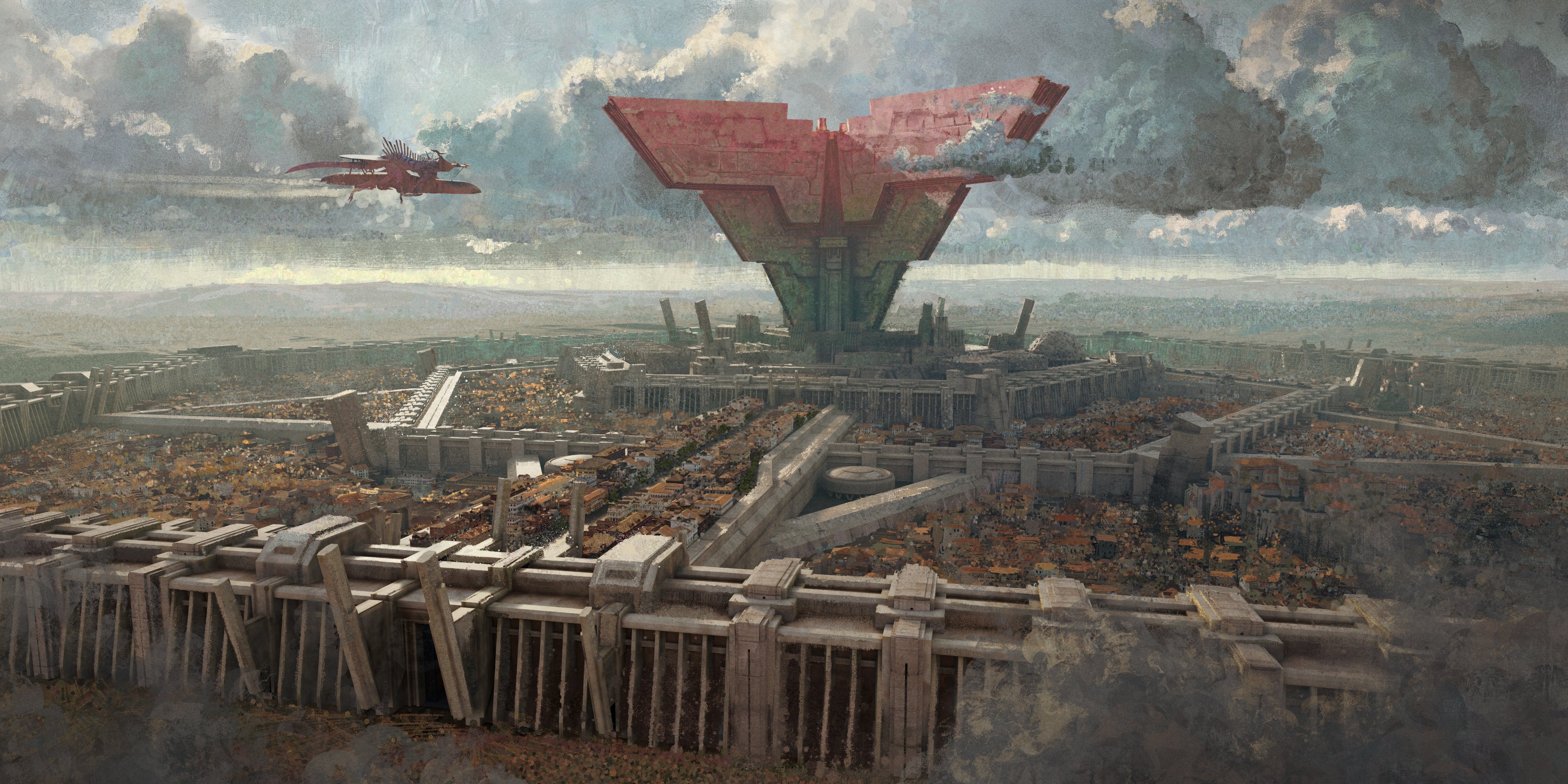 You ever just use blog posts as a worldbuilding mood board?
Memory and the Collective Unconscious
All life is connected via a metaphysical network that we call the "collective unconscious," but this understates its true depth and incomprehensibility. Those with poets' hearts often prefer "oversoul." Some scholars believe this is a defense mechanism, life metaphysically joining hands to stave off the next, and final, Death. An unfalsifiable claim, but some find it an inspiring idea.
Most of our memories are our own, but some float freely through the collective unconscious, offering glimpses of something else to those who know where to look. The discovery of these free memories lead to the development of engrams, discrete units of crystallized memory, usually distilled voluntarily from living folk, but occasionally plucked from the oversoul and given form. Engrams are useful for a variety of tasks and can even bring function to otherwise impossible machinery, but today we're going to talk about personal use.
Those looking to borrow some knowledge or a skill might integrate an engram. To do this, it must be inside of one's corporeal form, at least in part. While you could just eat it, it's hard to control the duration of use that way, so most wear them like a piercing, a fractal memory gem worn like an ear or nose stud. With focus and care, a person can access the memory within, borrowing its knowledge and ability (even muscle memory).
But it comes at a cost: long-term use risks the engram's memory overwriting some of your own. People who regularly employ engrams develop holes in their own identity, carved out and replaced by the scraps of someone else's.
Some allow this to happen on purpose. In a tradition that seems to have developed independently in multiple societies, rare individuals volunteer to have their bodies studded with engrams, sacrificing their own identities to serve as living repositories of communal memory. Grandchildren visit to speak with the echo of a beloved grandmother. Scholars consult facsimiles of the uniquely adept minds of mentors generations past. Parents bask in the warm memories of a child now grown. To those not raised in such societies, the practice is uncanny, perhaps even ghoulish. To those familiar, though, it is a way of maintaining an unbroken connection to history, memory kept alive not just in the telling, but with warm blood and beating heart.
 Tomomi Kobayashi's art for the SaGa series never gets old.
The Game Mechanic: Engrams and Experiences
I've posted before about an advancement system I'm tinkering with that's heavily inspired by Gestaltist's post We Haven’t Said Everything About Character Advancement Yet. My version of the system goes something like this:
- Experiences are traits that confer a fictional advantage to a PC when they attempt an action related to that Experience. This could mean greater impact, lesser risk, an alternative option, a lesser cost, or not having to roll a save, as fits the situation and Experience.
- At the end of each session, identify an important experience or memory for each PC. Anyone can suggest something for any PC, not just their own.
- Each player decides if they want to keep one of these as an Experience. They then roll a d6. If they roll above their current number of Experiences, they add the new Experience to the list.
- If they roll equal to or below their number of Experiences, or they choose not to attempt to add a new Experience, they gain 1 XP instead. XP can be used during downtime to progress projects or improve attributes.
- During downtime, a player can choose to combine Experiences that share a connection or a thematic link to create a more powerful, but more specific, Core Experience. This frees up Experience slots for future adventures.
Experiences aren't the only kind of trait: PCs also have Backgrounds or other traits that can be used in the fiction in similar ways. I mention this because it's relevant to engrams.
Using Engrams
Characters can "equip" engrams like magic jewelry, a limited number based on the character's ability to integrate foreign memory and skill. While equipped with an engram, the character has access to new Experiences or even a new Background trait. This might even grant new combat abilities or, for advanced (and difficult to use) engrams, specialized technical or magical knowledge. An adept user of engrams can temporarily become an expert in aetheric engines, just long enough to repair their strideship before removing the engram to use another time.
But as stated above in the worldbuilding, this comes with a cost: the user risks overwriting their own memory with the engram's. The exact mechanics of this are a very early draft right now, but here's the current version:
- Each time you call on an equipped engram's knowledge, add a tally mark beside it in your inventory. If you call on that same engram's knowledge three or more times in the same day, add d2 tally marks each time instead, until the next day.
- Tally marks clear naturally at a rate of one mark per week that the engram is not equipped. That means if you leave it "equipped" but don't use it, the tally marks don't clear: you have to fully remove it from your body to begin to clear them.
- Until an engram reaches three tally marks, there's no immediate risk.
- After adding the third tally mark, roll a d12. If you roll above the total number of marks, nothing happens.
- If you roll equal to or below the number of tally marks, the engram has begun to overwrite your own memories. Roll a d10. If the result is 1-6, a memory from the Engram overwrites the Experience in that slot permanently. If the result is 7-10, the memory instead overwrites a trait from your Background, also permanently.
- Core Experiences are more difficult to overwrite: the PC can roll a save to resist a memory overwriting a Core Experience, but even on a passed save, that Core Experience is marked. If an engram memory rolls that slot again, it's overwritten without a save, having been sufficiently eroded the last time.
- A PC with the right materials and skills (or someone to help them) can crystallize their own memories in engrams, providing some small assurance against their identity being overwritten. However, even personal engrams are subject to the same uncertainty: when leaving them equipped and allowing them to be integrated into your own psyche, you still have to roll the d10 to see where the memory goes, and it could very well overwrite another that you didn't expect. The mind does not distinguish between the source of external memories.
I'm not fully happy with the mechanics yet--I think I'd like memory overwriting to be simultaneously a longer-term concern, more immediately dramatic when it does happen, and less predictable--but this is what I'm testing it with right now.
The Last World
If you got this far, thanks for reading my first blog post about my new worldbuilding (and RPG) project, The Last World. These posts are essentially a mood board for worldbuilding, and a place to test out what prose style I want to use for the final work. If you recognize any of the art I'm including, consider that me wearing my influences on my sleeve.